Your agency wins the client. You nail the branding, the strategy, the design direction. Then the client asks for a custom WooCommerce integration, a CRM that talks to their booking system, or a feature that no plugin on the market actually does. Suddenly you are looking at hiring a developer, managing a build you cannot fully evaluate, and hoping it all holds together after launch.
White label WordPress development exists to solve exactly this problem. A development partner builds the technical work behind the scenes, your agency delivers it under your own brand, and the client never knows the difference.
This guide covers how white label WordPress development works, why agencies are increasingly choosing this model, and what to look for in a partner who will not let you down.
What Is White Label WordPress Development?
White label WordPress development is a partnership model where a specialist development team builds WordPress sites, plugins, custom functionality, or WooCommerce stores on behalf of your agency. The work ships under your brand. Your client sees your name, your logo, your invoice.
The development partner stays invisible.
This is not freelancer outsourcing where you find someone on a marketplace and hope for the best. A proper wp white label partnership means a consistent team that understands your standards, communicates on your schedule, and treats your clients like their own.
How it typically works:
- Your agency scopes the project with the client
- You brief your white label development partner on the technical requirements
- The partner builds, tests, and delivers the work to you
- You review, package it under your brand, and hand it to the client
- Ongoing maintenance and updates flow through the same channel
The client relationship stays yours. The technical execution is handled by people who do it every day.
Why Agencies Are Outsourcing WordPress Development
The economics of hiring in-house WordPress developers have shifted significantly. A mid-level WordPress developer in the UK commands a salary between 35,000 and 55,000 GBP per year before you factor in pension contributions, equipment, management overhead, and the inevitable bench time between projects.
For most branding and marketing agencies, that maths does not work – especially when development needs fluctuate from month to month.
Here is what agencies gain by working with wordpress development companies on a white label basis:
Lower overhead, higher margins
You pay for development only when you need it. No salaries during quiet months. No recruitment costs when your one developer leaves. Your margins on technical projects improve because you are not carrying fixed costs.
Focus on what you are actually good at
Your agency’s value is in strategy, branding, and client relationships. When you try to build a development department from scratch, your attention splits. White label development lets you stay in your lane while still offering full-service delivery.
Scale without the growing pains
Landed a large project that needs three developers for six weeks? A white label partner can staff up without you posting job ads. Lost a big client and need to scale back? You are not making anyone redundant.
Access to deeper technical expertise
Most agencies that try to hire a single “full-stack developer” end up with someone who is decent at many things but expert at none. A dedicated WordPress development company has specialists – backend developers, WooCommerce experts, API integration engineers – who handle complex work that a generalist would struggle with.
What a White Label WordPress Partner Actually Handles
If your experience with outsourced development has been limited to theme customisation and page builder tweaks, a proper white label WordPress development partnership is a different category entirely. Here is what it should cover.
Custom Plugin Development
Off-the-shelf plugins solve generic problems. When your client needs something specific – a bespoke booking system, a custom dashboard, a unique content management workflow – that means building a plugin from scratch.
For example, we have built complete examination systems with certificate generation and Stripe-based credit payments for clients in the education sector. No existing plugin came close to handling those requirements.
WooCommerce Builds and Automation
WooCommerce powers a huge share of UK ecommerce, but the gap between a default WooCommerce install and what clients actually need is often enormous. Custom checkout flows, multi-vendor marketplaces, automated order processing, subscription logic – these all require development work that goes well beyond installing extensions.
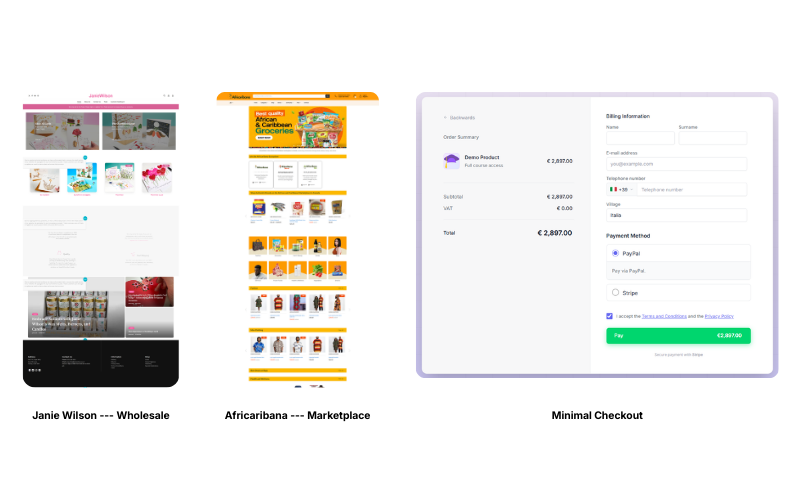
We have built everything from fully customised multivendor stores with multicurrency support to custom Stripe-like checkouts that replaced WooCommerce’s default flow entirely. For clients with complex ordering workflows, the standard WooCommerce setup simply cannot keep up – custom development is the only path.
CRM and Third-Party Integrations
Clients increasingly expect their website to connect to everything: their CRM, their booking system, their analytics, their email platform. These integrations rarely work out of the box.
Leadio is our own lead management CRM with built-in automation, Fathom analytics, and Cal.com scheduling integration – purpose-built for the kind of lead capture and nurturing workflows that agency clients ask for constantly.
AI-Powered Functionality
AI integration is no longer a novelty feature. Clients are asking for intelligent content generation, automated workflows, and AI-assisted tools embedded directly into their WordPress sites.
AI2WP lets users create pages using AI tools like Gemini, ChatGPT, or Claude and publish them as WordPress pages with a single click. This is the kind of functionality that agencies cannot deliver with a page builder – it requires real development.
White Label WordPress Development vs DIY Page Builders
A common question from agencies considering white label development: “Can we not just use Elementor or Divi and handle it ourselves?”
For simple brochure sites, absolutely. Page builders are great tools for straightforward layouts and content pages.
But here is where they hit a wall:
- Custom functionality – page builders do not write business logic. If the client needs a custom calculator, a dynamic pricing engine, or a booking system with specific rules, no amount of drag-and-drop will get you there.
- Performance – page builder sites often carry significant bloat. When a client’s site loads slowly and their Core Web Vitals suffer, the fix is usually cleaner custom code, not another plugin on top of the builder.
- Scalability – as a client’s business grows, their site needs grow with it. What started as a simple white label WordPress design project becomes a request for API integrations, automated workflows, and custom admin interfaces. Page builders cannot deliver that.
- Maintenance – builder-dependent sites can break when themes or plugins update. Custom-built functionality is more stable and easier to maintain long term.
The right approach is usually a combination: use a builder where it makes sense for layout and content, and bring in a development partner for everything that requires actual code.
How to Choose the Right White Label WordPress Development Partner
Not all white label WordPress development services are equal. Here is what to evaluate before committing.
Technical depth, not just theme tweaks
Ask what languages and technologies the team works with. If the answer is only “we customise themes,” that is not a development partner – that is a theme installer. Look for experience with custom plugin development, REST API integrations, WooCommerce customisation, and server-side logic.
Communication and project management
The biggest pain point in outsourced development is not technical quality – it is communication. Your partner should be responsive, proactive about potential issues, and comfortable working within your project management tools. If you cannot get a clear status update without chasing, that relationship will not last.
Portfolio with real complexity
Look for projects that demonstrate genuine problem-solving, not just attractive front-ends. Custom functionality, ecommerce builds with specific business logic, third-party integrations – these are the indicators of a team that can handle what your clients will throw at you.
Timezone and cultural alignment
Working with a white label WordPress development partner in a compatible timezone makes a measurable difference. Same-day communication, overlapping work hours, and shared understanding of UK business practices reduce friction significantly.
Willingness to stay invisible
This sounds obvious, but not every development team is comfortable being invisible. Your partner should have no issue with your agency taking full credit. No watermarks, no backlinks, no “developed by” footers unless you choose to include them.
What Does White Label WordPress Development Cost?
Pricing varies widely depending on the complexity of work and the model you choose.
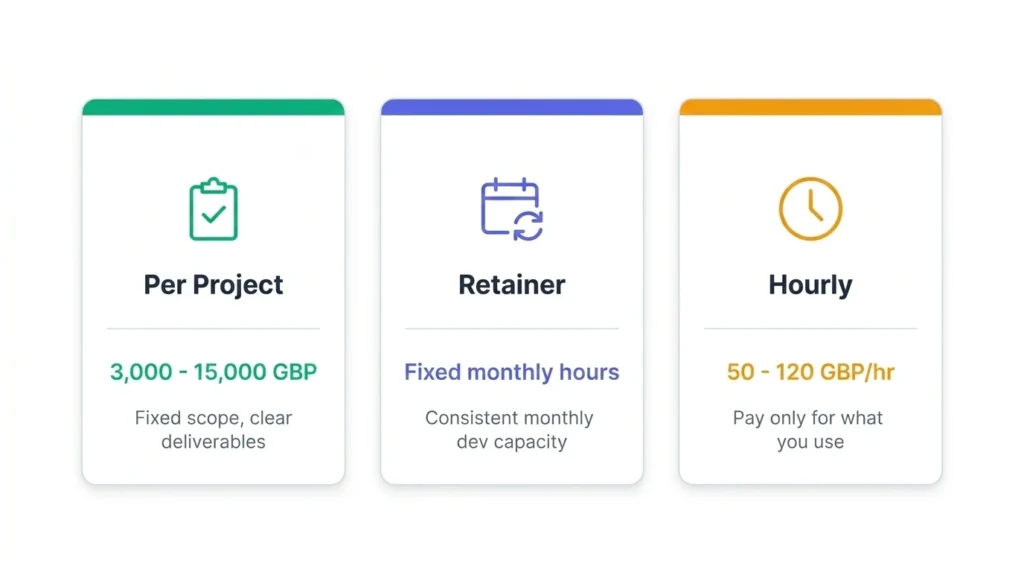
Common pricing models
- Per-project – fixed price for a defined scope. Works well for one-off builds with clear requirements. Typical range for a custom WordPress build in the UK: 3,000 to 15,000 GBP depending on complexity.
- Retainer – a set number of development hours per month at a discounted rate. Ideal for agencies with consistent, ongoing development needs.
- Hourly – pay for exactly what you use. Rates for UK-based WordPress development typically range from 50 to 120 GBP per hour depending on the team’s experience and specialisation.
What affects the price
- Complexity – a custom WooCommerce multi-vendor marketplace costs significantly more than a brochure site with a contact form
- Integrations – connecting to third-party APIs (CRMs, payment gateways, booking systems) adds development time
- Ongoing maintenance – factor in post-launch support, not just the initial build
- Urgency – rush timelines cost more, as they always do
Why cheapest is rarely best
The agencies that come to us after a bad outsourcing experience almost always chose the lowest bidder the first time. Cheap development often means poor code quality, no documentation, security vulnerabilities, and a site that breaks when WordPress updates. The cost of fixing bad work usually exceeds what proper development would have cost originally.
How We Work With Agencies
We are a WordPress development partner for agencies that need real technical capability without building an in-house team. No page builder work – custom development, WooCommerce builds, plugin creation, CRM integrations, and AI-powered functionality.
Our process:
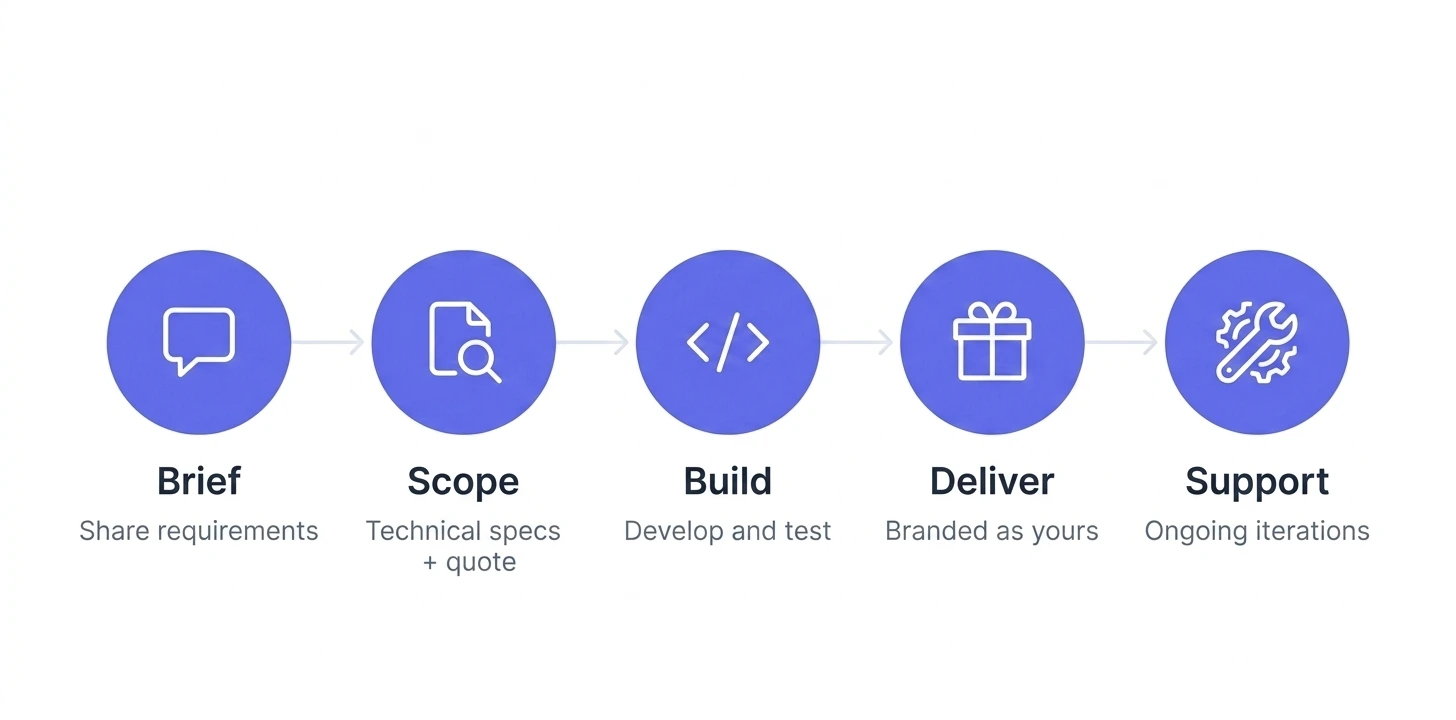
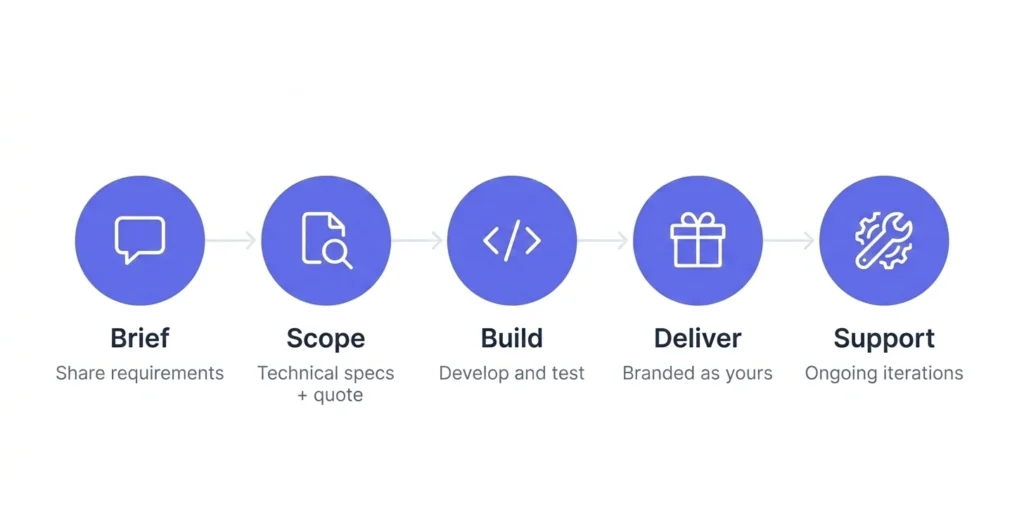
1. Brief – you share the project requirements and client goals
2. Scope – we break it down into technical specifications and provide a clear quote
3. Build – our team develops, tests, and documents everything
4. Deliver – you receive the finished work, branded as yours
5. Support – ongoing maintenance and iterations as the client’s needs evolve
We are featured as the development team on the Cuadro Group website – an agency that builds AI-powered digital systems for scaling brands.
Our portfolio spans industries from healthcare to ecommerce to sports, with custom functionality built for each.
Ready to talk?
Get in touch and tell us about your next project.
Frequently Asked Questions
Do my clients know you exist?
No. We work entirely behind the scenes. All communication goes through your agency, and all deliverables are branded as yours. Your client relationship is exactly that – yours.
What tech stack do you work with?
WordPress, WooCommerce, PHP, JavaScript, React, REST APIs, and third-party integrations (Stripe, Cal.com, Fathom, CRMs, AI APIs). We build custom plugins, custom themes, and bespoke functionality – not page builder layouts.
Can you handle ongoing maintenance?
Yes. Many of our agency partners keep us on retainer for ongoing development, updates, security patches, and feature additions. We treat your clients’ sites like our own.
How fast is turnaround?
It depends on scope. A simple integration might take a few days. A full custom WooCommerce build could take 4-8 weeks. We provide clear timelines during scoping and communicate proactively if anything changes.
Do you work with agencies outside the UK?
Absolutely. While we are primarily based around London and Leeds, we work with agencies globally. Timezone overlap and clear communication matter more than physical location.
